Gimpo Airport to Seoul (2026): Trains, Fares and Domestic Flights
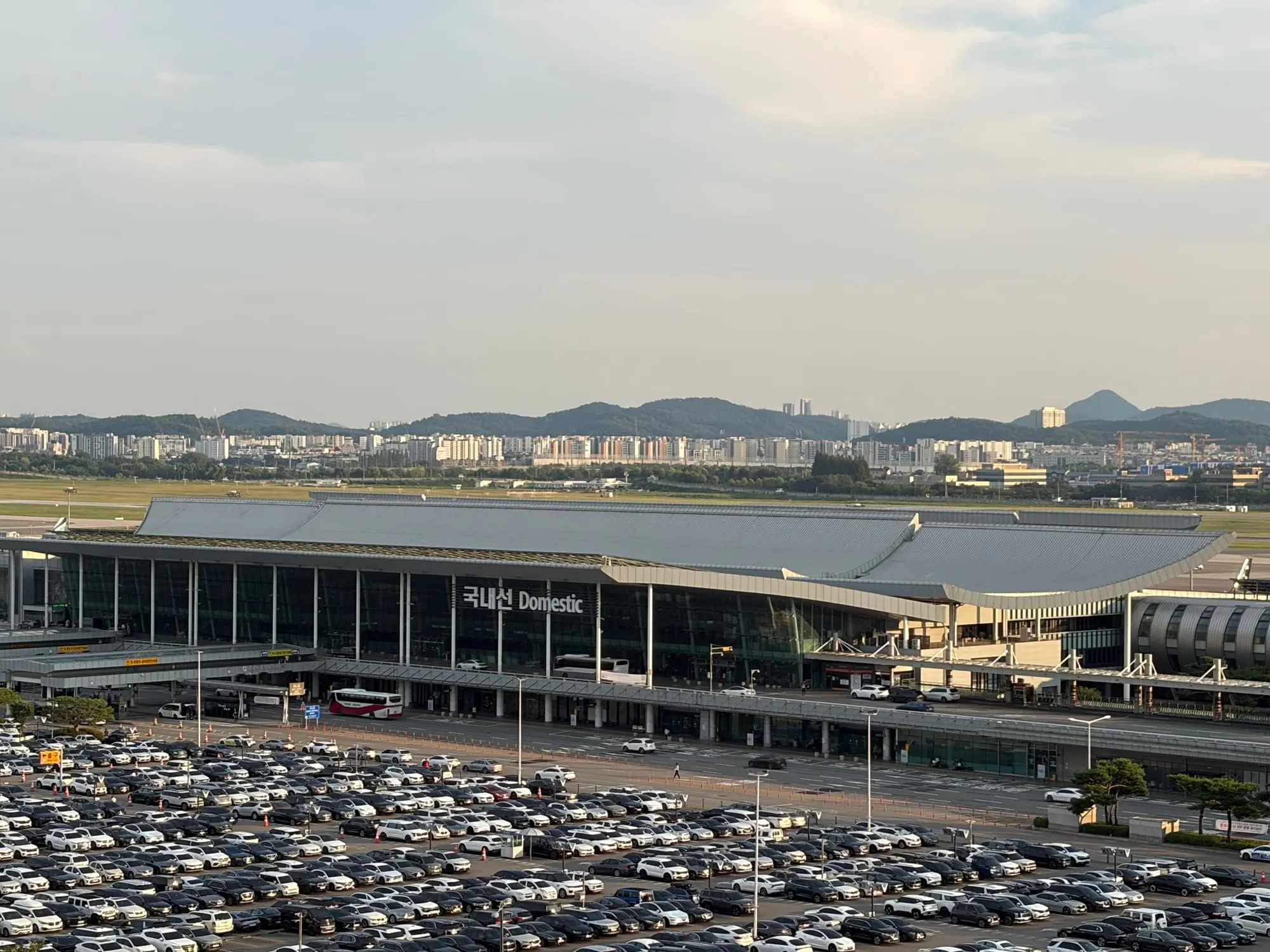
Quick answer: From Gimpo Airport to Seoul, take AREX (공항철도) for Seoul Station (₩1,750) or Hongdae (₩1,650), Line 9 express for Yeouido and Gangnam, or Line 5 for Gwanghwamun and Jongno. All three leave from Gimpo Airport Station, which also links to Incheon Airport by AREX for ₩4,350. Gimpo’s domestic flights go to six cities, including Jeju and Busan, and foreign visitors need their passport to board.
How do you get from Gimpo Airport to central Seoul?
Take the subway: Gimpo Airport Station (김포공항역) is a transfer hub for five rail lines, and three of them go straight into central Seoul. Fares are adult transit-card fares from each operator.
| Line | Best for | Key stops | Fare from Gimpo Airport |
|---|---|---|---|
| AREX all-stop (공항철도 일반열차) | Seoul Station, Hongdae, Gongdeok | Magongnaru, Digital Media City, Hongik Univ., Gongdeok, Seoul Station | ₩1,650 (Hongdae) · ₩1,750 (Seoul Station) |
| Line 9 express (9호선 급행) | Yeouido, Gangnam, COEX, Jamsil | Yeouido, Express Bus Terminal, Sinnonhyeon, Bongeunsa, Sports Complex | From ₩1,550, plus distance |
| Line 5 (5호선) | Gwanghwamun, Jongno, Dongdaemun | Yeouido, Gwanghwamun, Jongno 3-ga, Dongdaemun History & Culture Park | From ₩1,550, plus distance |
| Gimpo Goldline (김포골드라인) | Gimpo city (Gyeonggi) | — | Not for central Seoul |
| Seohae Line (서해선) | Gyeonggi suburbs | — | Not for central Seoul |
Subway fares start at ₩1,550 on a transit card for the first 10 km, plus ₩100 for every 5 km up to 50 km. A single-journey ticket costs ₩100 more on AREX and ₩1,650 base on the subway. Changing between subway lines inside the gates doesn’t add a new base fare; the trip is charged by total distance. To switch between the subway and a bus, tap out and board within 30 minutes (60 minutes between 21:00 and 07:00), or the transfer discount is lost.
If you don’t have a transit card yet, our T-money vs Climate Card guide explains which one to buy.
Which line should you take to your hotel?
Match the line to your neighborhood, not to the airport signs. Each line serves a different part of the city, and the wrong one can mean two extra transfers.
- Staying near Seoul Station, Hongdae or Gongdeok: AREX. Board the all-stop train (일반열차) toward Seoul Station. The AREX Express (직통열차) only runs nonstop between Seoul Station and Incheon Airport and doesn’t stop at Gimpo. The ride to Seoul Station takes about 28 minutes on the train (checked by our editor in Naver Map), plus walking time to and from the platforms.
- Staying in Yeouido, Gangnam, COEX or Jamsil: Line 9. Board an express (급행) train. Line 9 runs local and express trains one-for-one on the same track, and Gimpo Airport is an express stop. Sinnonhyeon is the express stop for Gangnam, Bongeunsa for COEX, and Sports Complex (Line 2) or Seokchon (Line 8) for Jamsil.
- Staying in Gwanghwamun, Jongno or Dongdaemun: Line 5. It runs through the old city center with no transfer.
- Staying in Myeongdong: AREX to Seoul Station, then Line 4 one stop to Hoehyeon or two to Myeongdong.
One common mistake: Line 5 does not stop at Seoul Station. Use AREX for Seoul Station and KTX connections.
Line 9 express trains get crowded at weekday morning rush. The operator itself advises using local trains in rush hour; if you have big suitcases, a local train is easier.
How do you transfer between Gimpo and Incheon?
Take the AREX all-stop train: Gimpo Airport to Incheon Terminal 1 costs ₩4,350 and to Terminal 2 ₩4,950 on a transit card. Trains run on the same line as the Seoul-bound service, so you board from the AREX platform at Gimpo Airport Station and ride toward Incheon Airport.
Check which Incheon terminal is printed on your ticket before you board. Terminal 2 is the last stop, one stop after Terminal 1, and AREX charges ₩600 more to ride on to it. Asiana Airlines moved all its flights to Terminal 2 on 14 January 2026, so connecting to an Asiana flight now means riding to the end of the line.
Some Airport Limousine (공항리무진) routes between Incheon and Seoul also stop at Gimpo Airport, including 6003 and 6014. Between Gimpo and Incheon the fare is ₩8,000 for adults and ₩6,000 for elementary-school children; middle-school students and older pay the adult fare (Airport Limousine fare table, checked by our editor in October 2026).
Where can you fly from Gimpo?
Gimpo flies domestic routes to six Korean airports and international routes to eight East Asian airports. These counts come from Korea Airports Corporation’s (KAC, 한국공항공사) schedule for Wednesday 28 October 2026, under the winter timetable that started on 25 October 2026 and runs to late March 2027.
| Destination (Korean) | Gimpo departures that day | Scheduled flight time | Airlines |
|---|---|---|---|
| Jeju (제주) | 108 (06:00–21:00) | Mostly 75 min | Korean Air, Asiana, Jeju Air, Jin Air, Eastar Jet, Trinity Airways, Air Busan, Air Seoul, Parata Air |
| Busan Gimhae (부산/김해) | 22 (06:50–20:10) | Mostly 65 min | Air Busan, Korean Air, Trinity Airways, Eastar Jet, Jin Air, Jeju Air |
| Jinju/Sacheon (진주/사천) | 6 | 65–75 min | Sum Air, Jin Air |
| Yeosu (여수) | 3 | 60 min | Asiana, Jin Air |
| Gwangju (광주) | 2 | 60 min | Asiana |
| Ulsan (울산) | 3 | 60 min | Korean Air, Jin Air |
There is no Gimpo–Daegu route on KAC’s schedule; Daegu trips from Seoul mean KTX or a flight from another airport. The Gimpo–Pohang-Gyeongju flight that ran in the summer isn’t on the winter timetable. Some flights run only on certain days or until a set date, so check the airline’s schedule for your travel date before you book.
International routes from Gimpo: Tokyo Haneda (12 departures that day), Osaka Kansai (10), Shanghai Hongqiao (4), Beijing Capital (3), Taipei Songshan (2), Nagoya Chubu (2), Kaohsiung (1) and Beijing Daxing (1). If you shop before an international departure, read our Korea tax refund guide; Gimpo is one of the airports where you can claim.
How do domestic flights work for foreign visitors?
Bring your passport: KAC checks ID and boarding pass at the entrance to domestic departures, and a passport is the ID a foreign visitor will have. The rest works like a short-haul flight anywhere, with a few Korean rules.
- Book with the airline or a booking site and note your airline’s check-in cutoff. Korean Air closes domestic check-in 30 minutes before departure (checked by our editor on Korean Air’s site); other airlines set their own, so read it on your booking.
- Check in at your airline’s counter or kiosk, or use a mobile boarding pass. Drop checked bags at the counter.
- Pack carry-on within limits. KAC’s general guide is 55 × 40 × 20 cm (115 cm total) and 10 kg; your airline’s rule may differ.
- Show your passport and boarding pass at the departures entrance. Take off masks, hats and sunglasses for the ID check.
- Go through security. Knives, scissors and tools go in checked bags. Korea’s 100 ml limit on liquids, aerosols and gels in the cabin applies to international flights only, so it doesn’t apply on domestic routes. Dangerous goods such as fuel, bleach and pesticides are banned on every flight.
- Keep power banks in your hand luggage, never in checked bags. Since 20 April 2026, you can carry at most two per person (160 Wh / 43,000 mAh or less each; those over 100 Wh need airline approval), and you may not charge them or use them to charge a phone during the flight. Lighters are limited to one per person.
What changed recently
- 20 April 2026: Power banks limited to two per passenger, with no charging or use on board. Overhead-bin storage was already banned after the January 2025 Air Busan fire.
- 10 September 2026: T’way Air started flying as Trinity Airways (트리니티항공). The flight code stays TW.
- 1 October 2026: Seoul’s Climate Card short-term pass now covers subways inside Seoul only. Areas it used to cover outside Seoul, including Gimpo city, are no longer included.
- 25 October 2026: Gimpo’s winter timetable started. The Pohang-Gyeongju route dropped off, Busan gained flights, and Jeju runs 06:00–21:00.
FAQ
Does the AREX Express train stop at Gimpo Airport?
No. The Express (직통열차) runs nonstop between Seoul Station and Incheon Airport. From Gimpo, take the all-stop train: ₩1,750 to Seoul Station or ₩4,350 to Incheon Terminal 1.
Can I use the Climate Card from Gimpo Airport?
Yes. Gimpo Airport is in Gangseo-gu, Seoul, so Line 5 and Line 9 rides into the city are covered. Seoul also lists the six AREX stations inside Seoul, including Gimpo Airport, Hongik Univ. and Seoul Station, as Climate Card stations, so the AREX ride to Seoul Station works too. Since 1 October 2026 it no longer covers Gimpo city, so don’t use it on the Gimpo Goldline.
Do foreigners need a passport for domestic flights in Korea?
Yes. KAC checks ID with your boarding pass at the domestic departures entrance, and a passport is the accepted ID you’re likely to have. Keep it with you, not in your checked bag.
Is there a flight from Gimpo to Daegu?
Not on KAC’s current Gimpo schedule. Gimpo’s domestic routes go to Jeju, Busan, Gwangju, Yeosu, Ulsan and Jinju/Sacheon.
Which is faster to Gangnam: Line 9 or AREX?
Line 9. Its express trains run from Gimpo Airport to Sinnonhyeon in Gangnam without a transfer, while AREX would need at least one transfer from Seoul Station or Hongdae.
Related guides
 Getting Around
Seoul to Jeju Flight Guide (2026): Gimpo Times, Airlines and Costs
Seoul to Jeju flight guide: about 103 Gimpo departures a day from 06:00 to 21:00, 75 minutes in the air, nine airlines, and what the fare adds up to.
 Getting Around
Incheon Airport Overnight Guide (2026): Early Flights, Beds, Buses
Incheon Airport overnight for an early flight: night buses reach T1 until 04:50, first AREX leaves Seoul 05:20, and where to sleep in the terminal.
 Getting Around
Incheon Layover: Free Transit Tours and Going into Seoul (2026)
Incheon layover guide: official transit tours of 3–5 hours for layovers up to 24 hours, every route and day, plus nap zones, showers and AREX to Seoul.
Sources
- Ministry of Land, Infrastructure and Transport — Q&A: liquids and gels in carry-on are restricted on international flights (Korean)
- Aju News — Asiana Airlines moves to Incheon Terminal 2 on 14 January 2026 (Korean, 4 Nov 2025)
- Seoul Metropolitan Government — Climate Card at the six AREX stations inside Seoul, incl. Gimpo Airport (Korean, Sept 2024)
- AREX — All-stop train fare table by station, incl. Gimpo Airport (Korean)
- AREX — All-stop train overview: stations and transfer lines (Korean)
- AREX — Express train overview: Seoul Station–Incheon nonstop (Korean)
- Seoul Metro Line 9 — Express and local train stops (Korean)
- Seoul Metro Line 9 — Fares and transfer rules (Korean)
- Seoul Metro Line 9 — Rush-hour crowding and local-train advice (Korean)
- Korea Airports Corporation — Gimpo domestic flight schedule (Korean)
- Korea Airports Corporation — Gimpo international flight schedule (Korean)
- Korea Airports Corporation — Gimpo departure steps: ID check, carry-on, batteries (Korean)
- Korea Airports Corporation — Gimpo prohibited items (Korean)
- Airport Limousine (공항리무진) — Routes via Gimpo Airport (Korean)
- Seoul Metropolitan Government — Climate Card short-term pass FAQ (Korean)
- Seoul Metropolitan Government — Climate Card coverage (Korean)
- Seoul Metro — Cyber Station (Line 4 and Line 5 stations, Korean)
- Ministry of Land, Infrastructure and Transport press release via Korea.kr — Two power banks per passenger, no in-flight charging or use from 20 April 2026 (Korean)
- Kyongbuk Maeil — T'way Air begins flying as Trinity Airways, 10 Sept 2026 (Korean)