Seoul Subway Guide (2026): Fares, Transfers and Etiquette
Quick answer: This Seoul subway guide comes down to three rules. Pay with a transit card (T-money or a Climate Card): an adult ride costs ₩1,550 for the first 10 km, versus ₩1,650 for a single-journey ticket. Changing between subway lines inside the gates is free, and bus–subway transfers are free within 30 minutes (60 minutes after 9 p.m.) as long as you tap out every time you leave a train or bus.
The Seoul subway (서울 지하철) is one fare system that also covers the surrounding Gyeonggi and Incheon lines. Signs, maps and announcements are in Korean and English. Fare rules below come from Seoul Metro (서울교통공사) and the Seoul Metropolitan Government; one distance-based fare system covers the whole metropolitan subway network.
Which ticket should you use on the Seoul subway?
Use a rechargeable transit card unless you’ll ride only once or twice. A card is ₩100 cheaper per ride, gets free transfers to buses, and saves you a trip to the deposit machine.
| T-money card (티머니) | Climate Card short-term pass (기후동행카드) | Single-journey ticket (1회용 교통카드) | |
|---|---|---|---|
| How you pay | Pay per ride from a balance | Flat price, unlimited rides | Pay per ride, buy each time |
| Adult base fare | ₩1,550 | Included in the pass | ₩1,650 + ₩500 deposit |
| Transfers to buses | Yes, free within the time limit | Yes, on Seoul buses | No |
| Works outside Seoul | Yes, nationwide | No | Seoul metropolitan subway only |
| Best for | Most visitors | Heavy riders staying inside Seoul | A one-off ride |
Choosing between the two cards depends on how many rides you take and whether you leave Seoul. We compare them in detail in T-money vs Climate Card.
How much does the Seoul subway cost?
An adult ride costs ₩1,550 by card for up to 10 km, then ₩100 more for every 5 km up to 50 km. Beyond 50 km, the extra ₩100 kicks in every 8 km. Fares are based on the shortest route between your entry and exit stations, whatever route you actually take.
| Trip distance | Adult card fare | Adult single-journey ticket |
|---|---|---|
| Up to 10 km | ₩1,550 | ₩1,650 |
| 10–15 km | ₩1,650 | ₩1,750 |
| 20–25 km | ₩1,850 | ₩1,950 |
| 30–35 km | ₩2,050 | ₩2,150 |
We worked out these examples from Seoul Metro’s fare rules (current since the 28 June 2025 fare change). Your map app shows the exact fare for a route before you ride.
Youth and child fares: Teens aged 13–18 pay ₩900 by card (₩80 per extra 5 km), but a single-journey ticket charges them the adult price. Children aged 6–12 pay ₩550 (₩50 per extra 5 km), the same on a card or a ticket. Children under 6 ride free, up to three per accompanying adult.
Early-bird discount (조조할인): If you tap in with a card before 06:30, the base fare is 20% off (₩1,240 instead of ₩1,550). It doesn’t apply if you’re transferring from a bus.
How do transfers work?
Changing between subway lines is free as long as you stay inside the gates: follow the colored signs for the line you want. You only pay one distance-based fare for the whole trip, calculated when you tap out at the end.
Switching between the subway and a bus is also free, with conditions from Seoul’s integrated transfer system (통합환승할인):
- Tap your card when you leave the train or bus. If you don’t tap out, the transfer breaks and the next ride is charged as a new trip.
- Board the next vehicle within 30 minutes of tapping out. Between 21:00 and 07:00 you get 60 minutes.
- Count your transfers: up to 4 transfers (5 rides) count as one trip.
- Don’t re-board the same route. Getting back on the same bus line or the same vehicle isn’t a transfer.
The combined fare is distance-based: ₩1,550 covers the first 10 km, plus ₩100 per 5 km after that. If one leg is on a bus with a higher base fare, you pay that higher base. The system covers Seoul, Gyeonggi and Incheon buses, the Seoul subway, KORAIL metro lines, AREX (공항철도) and GTX-A.
Use one card per person. Subway gates let one person through per card; only on buses can you ask the driver to charge several riders to one card (다인승), and those riders lose the transfer discount onto the subway.
How do you read the lines and directions?
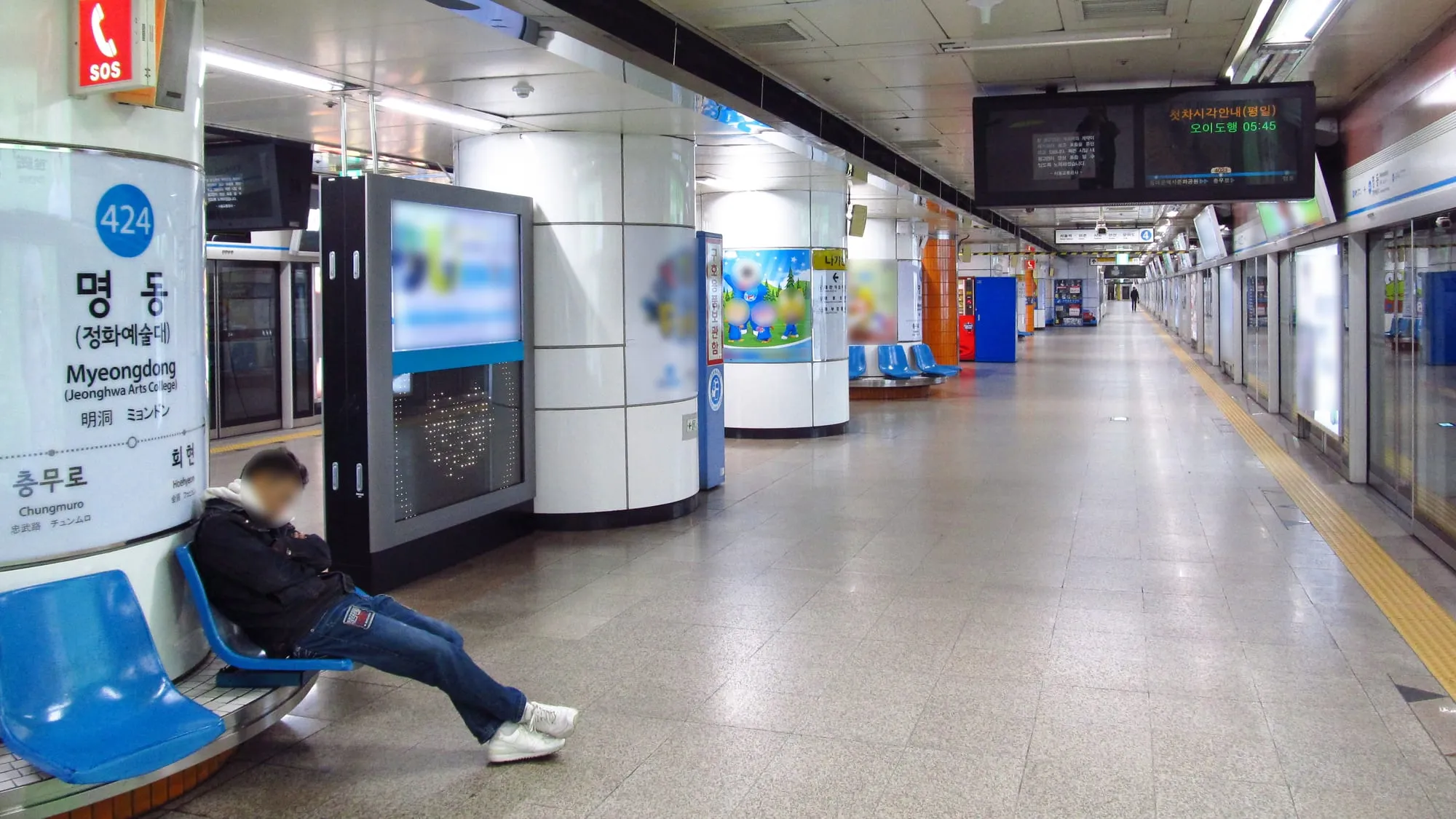
Each line has a number and a color, and every station has a three-digit number. For example, Myeongdong (명동) on Line 4 is 424. Signs on the platform show the station you’re at, the next station, and the direction (the end of the line).
Three lines confuse first-timers:
- Line 2 (2호선) is a loop around the city. Trains running clockwise are signed inner loop (내선순환); counterclockwise is outer loop (외선순환). Check the next station name instead of the loop name, and you won’t go the long way round.
- Line 9 (9호선) runs both express (급행) and local (일반) trains. Express trains skip many stations, so check the train type on the platform screen before you board.
- Lines that leave Seoul, such as the Shinbundang Line (신분당선) to Pangyo, can cost more than a regular ride. For example, Sillim to Pangyo costs ₩2,850 on a transit card (Naver Map, October 2026). The fare is deducted when you tap out.
Exits are numbered too. Map apps and hotel directions usually say something like “Exit 6,” and taking the wrong one can put you across a large intersection.
How do you buy a single-journey ticket?
Buy it at the ticket machines in any station, then get ₩500 back after your ride.
- Find a single-journey ticket machine (1회용 발매·교통카드 충전기) near the gates and switch the screen to English.
- Choose your destination station or fare. The machine charges the fare plus a ₩500 deposit.
- Pay. Cash works everywhere. Since 17 March 2026, 440 new-type machines in 273 stations on Lines 1–8 also take foreign Visa and Mastercard cards, Kakao Pay and Naver Pay, at an average 3.7% fee.
- Tap the ticket at the gate going in and coming out.
- At your destination, put the ticket into a deposit refund machine (보증금 환급기) in the station to get your ₩500 back.
A lost or damaged ticket forfeits the deposit. Remember that a ticket doesn’t give you a free bus transfer, so a card is the better deal from your second ride.
What time does the Seoul subway run?
Trains run from about 5:30 a.m. until around midnight. At Sillim (Line 2), for example, the first weekday train leaves at 05:39 and the last ones at 23:50–23:57 depending on direction (Naver Map, October 2026). Timetables also change on weekends and public holidays, and Seoul adjusts service around big national events and festivals, sometimes running later trains or skipping stations near the crowds. Check your first and last trains in a map app (Naver Map or Kakao Map) on the day rather than relying on a fixed hour.
Last trains differ by line and by direction. If you’ll be out late, check the last train in a map app (Naver Map or Kakao Map) or on the timetable posted in the station before dinner. Missing a last connection at a transfer station is the common trap, because the second line may stop before the first.
Possible delays from 20 November 2026: The union at Seoul Metro, which runs Lines 1–8, plans a work-to-rule from 20 November, after 86.3% of voters backed industrial action. Work-to-rule means staff follow every procedure strictly, which can slow trains. The union says it will strike if talks stall, but no strike date is set. If you’re riding around then, leave extra time and check Naver Map or station announcements on the day.
What are the unwritten rules on the subway?
Seoul’s subway has two kinds of reserved seats, and leaving them free is the main etiquette rule.
- Priority seats (교통약자석): On Lines 1–8, each car has 12 designated seats at both ends for older people, people with disabilities and pregnant women, plus 7 courtesy seats in the middle. If you’re not in one of those groups, leave the end seats free.
- Pregnant women’s seats (임산부 배려석): Two pink seats per car, with pink seat cushions and backrests. Seoul asks riders to leave them free, including for women in early pregnancy who don’t look pregnant.
A few other habits help you blend in. Stand to one side of the train doors and let people off first. Keep phone calls short and quiet. Wear a large backpack on your front or put it down at rush hour.
What changed recently
- 28 June 2025: The adult subway base fare rose from ₩1,400 to ₩1,550 on a card.
- 17 March 2026: New ticket machines in Line 1–8 stations started accepting foreign-issued cards, Kakao Pay and Naver Pay for single-journey tickets and Climate Card passes (average 3.7% fee).
FAQ
Can I tap a foreign credit card at the subway gate?
Seoul’s official pages only cover paying with foreign cards at ticket machines, not tapping them at the gates. Use a T-money card, a Climate Card or a single-journey ticket to get through.
Do I have to tap out when I leave the subway?
Yes. The gate calculates your distance fare when you tap out, and tapping out is also what keeps your free transfer to a bus.
Is changing lines free on the Seoul subway?
Yes, as long as you stay inside the gates. You pay one distance-based fare for the whole trip, charged when you exit.
Can two people share one T-money card?
Not on the subway. Each tap at the gate lets one person through, so every rider needs their own card. On a bus you can tell the driver how many people are paying and they’ll charge one card for everyone, but those riders lose the transfer discount onto the subway. Give each rider their own card.
What if I lose my single-journey ticket?
You lose the ₩500 deposit. If you can’t get through the exit gate without it, press the help button at the gate or ask station staff.
Related guides
 Getting Around
Climate Card or T-money? Which Seoul Transit Card to Buy (2026)
Seoul-only trip with lots of rides? Get a Climate Card short-term pass. Leaving Seoul or riding little? Get T-money. The Korea Tour Card is no longer sold.
 Getting Around
Seoul Night Bus, Last Trains and Taxis: Getting Home Late (2026)
Seoul night bus guide: 14 N-bus routes from about 23:00 to 04:00 for ₩2,500, when the last subway runs, and what late-night taxi surcharges add.
 Getting Around
Jeju Without a Car: Bus Routes, Fares and Taxis (2026)
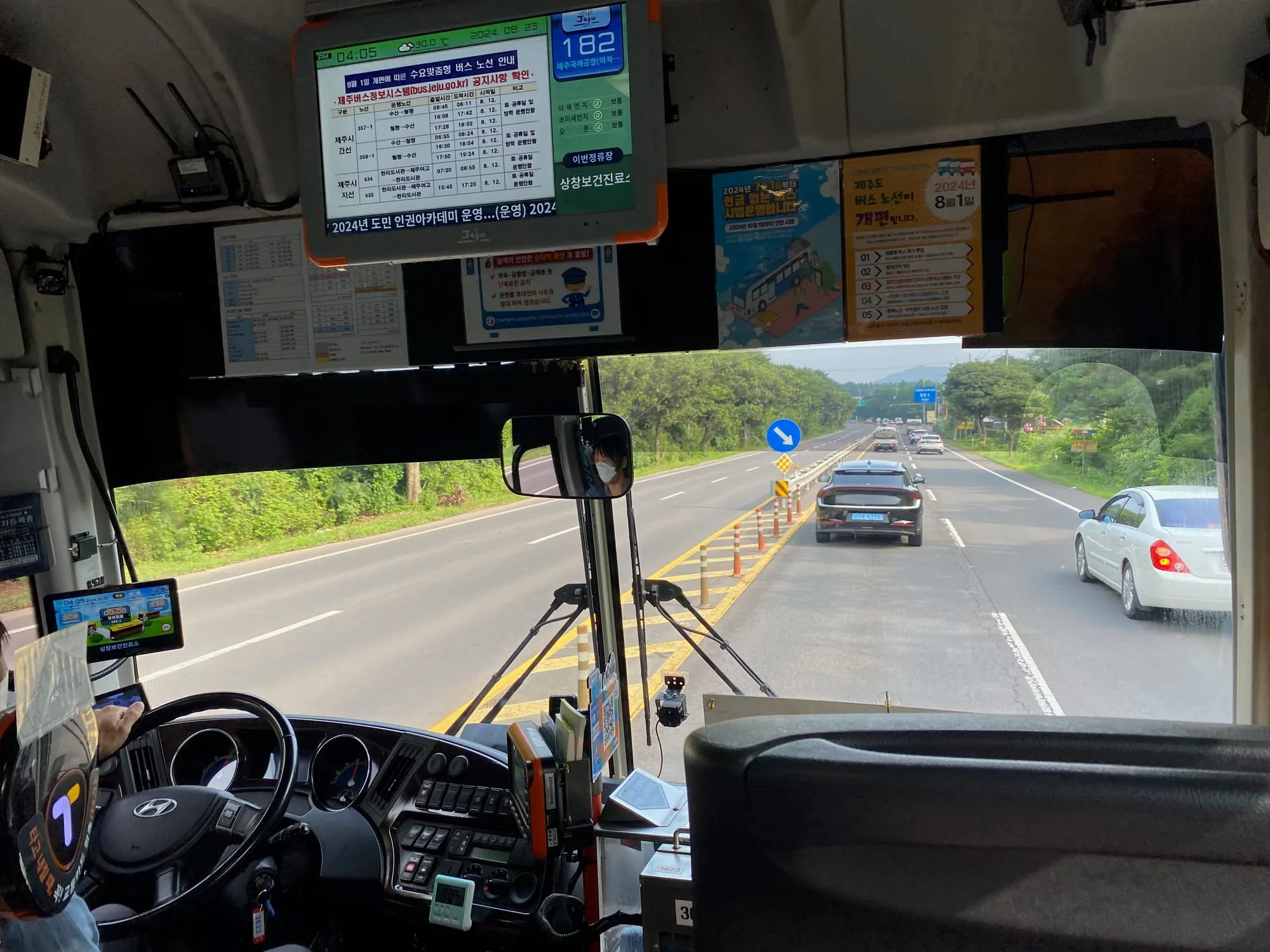
Seeing Jeju without a car works by bus: ₩1,150 per ride on a T-money card, ₩3,000 max on expresses. Buses no longer take cash, so get a card first.
Sources
- Seoul Metro — Fare guide (Korean)
- Seoul Metropolitan Government — Integrated transfer discount rules (Korean)
- Seoul Metropolitan Government — Subway and bus fare tables (Korean)
- Seoul Metropolitan Government — Single-journey transit card and ₩500 deposit (Korean)
- Seoul Metropolitan Government — Foreign-issued cards accepted at ticket machines from 17 March 2026 (Korean)
- Seoul Media Hub — Line 2 inner loop and outer loop explained (Korean)
- Seoul Metropolitan Government — Priority seats on the subway (Korean)
- Seoul Media Hub — Weekday subway service extended to 1 a.m. (Korean, 2022)
- Seoul Metropolitan Government — Line 9 express and local trains (Korean)
- Shinbundang Line (DX Line) — Fare guide with section surcharges (Korean)
- Seoul Media Hub — Pink pregnant women's seats (Korean, 2015)
- Seoul Metropolitan Government — Climate Card short-term pass FAQ and coverage (Korean)
- Etoday — Metropolitan subway base fare rises from ₩1,400 to ₩1,550 on 28 June 2025 (Korean news)
- Kyunghyang Shinmun — Seoul Metro union backs industrial action; work-to-rule from 20 November (Korean, 5 Nov 2026)