Jeju Without a Car: Bus Routes, Fares and Taxis (2026)
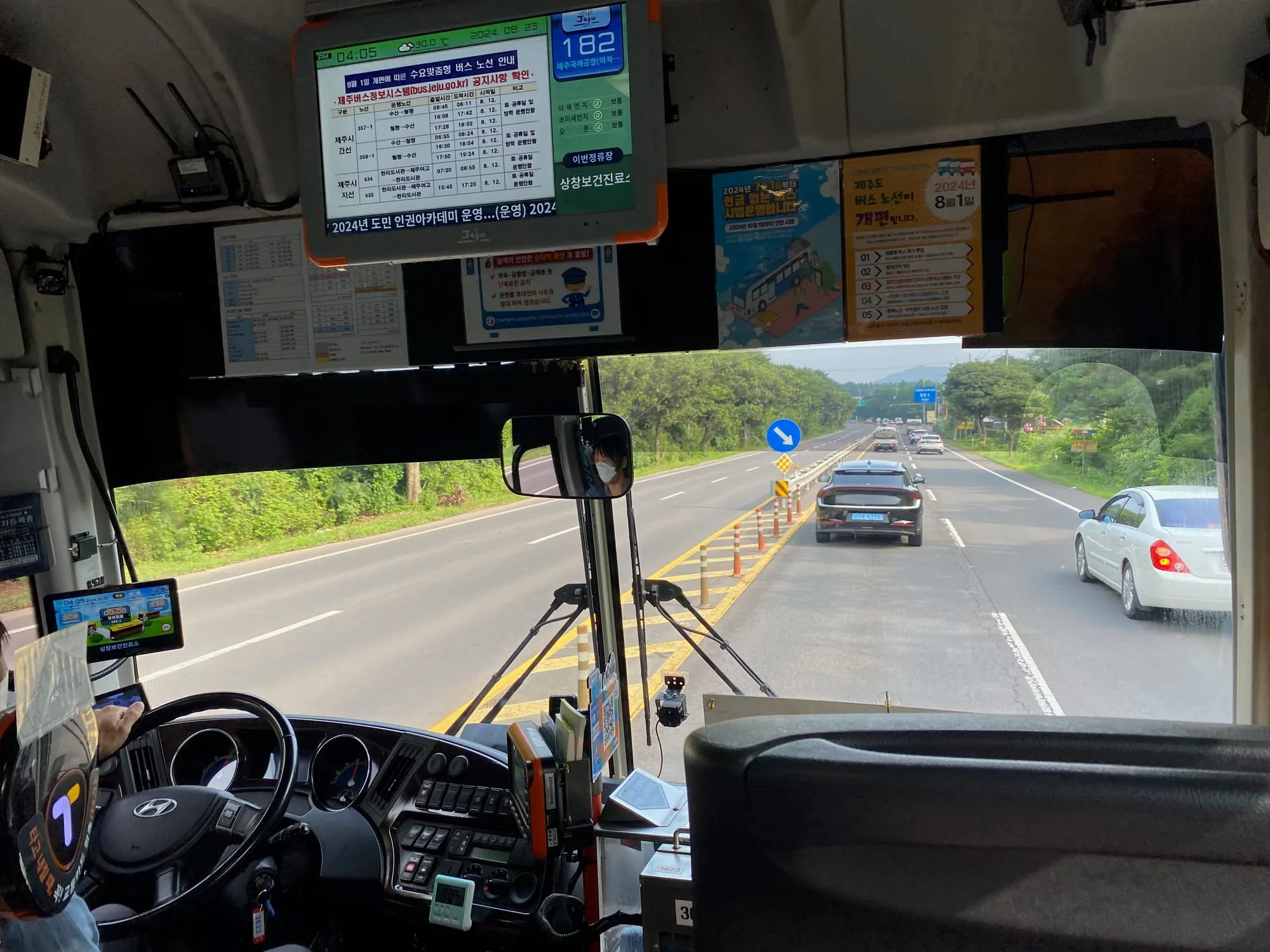
Quick answer: Yes, you can see Jeju without a car if you base yourself in Jeju City or Seogwipo and plan around bus routes. Regular buses cost ₩1,150 per ride on a T-money card and express buses top out at ₩3,000, with free or discounted transfers within 40 minutes. Buses stopped taking cash on 1 October 2024, so buy a transit card before your first ride, and use taxis for the inland spots buses serve rarely.
Jeju (제주) runs a single island-wide bus network, with express buses from Jeju City (the airport or the bus terminal) to every coast. This guide uses the official Jeju Bus Information System (제주버스정보시스템) and provincial press releases.
Is it realistic to travel Jeju without a car?
It works well for coastal towns, beaches and the big sights, and less well for remote inland stops. Pick it if you’re happy with two or three sights a day; rent a car or book tours if you want to hop between inland oreums and cafés.
- Easy by bus: Jeju City, Seogwipo, Jungmun resort area, Hamdeok beach, Seongsan Ilchulbong, Pyoseon, Moseulpo port.
- Workable with a transfer: Bijarim forest and the Shinhwa World area, via tourist circulation buses.
- Harder: mid-mountain (중산간) villages, where Jeju runs on-demand buses and service is thinner.
Two bases cut travel time: a few nights in Jeju City for the north and east, then a few in Seogwipo or Jungmun for the south and west.
How much do Jeju buses cost, and how do you pay?
You pay by tapping a transit card; there is no cash option. Jeju’s buses went cashless on all routes on 1 October 2024, and the cash boxes were removed. A short period when riders without a card could pay by bank transfer ended on 31 December 2024.
| Bus type (Korean) | Adult fare on card | What it is |
|---|---|---|
| Trunk and branch buses (간선·지선) | ₩1,150 flat | Most city and coastal routes |
| Tourist circulation buses (관광지순환) | ₩1,150 flat | Loops from transfer hubs to sights |
| Express buses (급행) | ₩2,000 for the first 20 km, then +₩200 per 5 km, max ₩3,000 | Jeju City to each coast, few stops |
| Airport limousine 600 / 800 | ₩1,300–5,500 / ₩1,300–5,000 by distance | Airport to Jungmun and Seogwipo hotels |
Teens pay ₩850 and children ₩350 on regular buses, but only on a card registered for the discount.
What card works: any nationwide prepaid card, such as T-money (티머니) or Cashbee, bought and topped up at convenience stores. A T-money card from Seoul works here. Seoul’s Climate Card unlimited pass does not. See our T-money vs Climate Card guide for buying and refunding T-money.
Jeju also added a QR code payment (via ZeroPay) for foreign tourists on 1 August 2024. The province’s announcement doesn’t list which overseas apps work with it, so if you’re from the US, UK, Canada or Australia, plan on a T-money card.
Free 65+ rides are for Jeju residents only. They use a local welfare card, so visiting seniors pay the normal fare.
How do bus transfers work?
Tap your card when you get off, and your next bus within 40 minutes is free or discounted. You get up to two transfers per trip.
- Tap on when you board. On express buses you pay ₩2,000 here.
- Tap off on the reader when you leave. Express buses charge any extra distance at this point, so tapping off matters even more.
- Board your next bus within 40 minutes. If its fare is the same or lower, the ride is free; if it’s higher, you pay only the difference.
- Don’t count on transferring to the same route number, including the return direction (111 to 111 doesn’t count). Routes that share the first three digits, like 810-1 and 810-2, also don’t count.
Example from the official fare table: a regular bus (₩1,150) then an express (₩2,000) costs ₩2,000 in total, not ₩3,150.
How do you get from Jeju Airport to your hotel?
Walk out of Gate 2 for city and intercity buses, Gate 5 for airport limousines, or Gate 3 for taxis.
| Going to | Bus | Notes |
|---|---|---|
| Jeju City old town, Dongmun Market, Hamdeok | 303 (urban express, new June 2026), city trunk routes | 303 stops only at designated stops |
| Jungmun resort (중문) | Limousine 600 | Hotels, convention center, then Seogwipo KAL Hotel; 601 ends at the convention center |
| Seogwipo city (서귀포) | Express 181 / 182, limousine 800 | 181 goes via the 516 road, 182 via Pyeonghwa-ro |
| Seongsan (성산) | Express 111 | Airport to Seongsan port via Songdang |
| Pyoseon / Jeju Folk Village | Express 121 / 122 | Via Beonyeong-ro |
| East coast to Namwon | Express 101 | Coastal road (동일주로) |
The 800 does not go through Jungmun, so pick the 600 if your hotel is in the resort area. Jeju plans to add buses to the busy 111, 151, 182 and 600 routes in December 2026.
Which bus goes to the main sights?
Most sights sit on one of a few trunk lines out of Jeju Bus Terminal (제주버스터미널), or on a short loop from a transfer stop.
| Sight or area | Bus | Board at |
|---|---|---|
| Seongsan Ilchulbong (성산일출봉) | 201 (slow, east coast) or express 111 | Jeju Bus Terminal / Airport |
| West coast and Gosan (고산) | 202 (west coastal road) | Jeju Bus Terminal |
| Moseulpo port (모슬포남항) | Express 102 or 151 | Jeju Bus Terminal |
| Hallasan, Eorimok trail (어리목) | 240 (1100 road) | Jeju Bus Terminal |
| Seogwipo via the 516 road | 281 | Jeju Bus Terminal |
| Bijarim forest (비자림) | 810-1 / 810-2 loop | Daecheon transfer stop (대천환승정류장) |
| Shinhwa World area (신화역사공원) | 820-1 / 820-2 loop | Donggwang transfer stop (동광환승정류장) |
For live arrivals, use the Jeju Bus Information System website, which has an English version. The official Jeju bus info app was discontinued in July 2026; Jeju now tells riders to add the website to their phone’s home screen instead. Jeju’s buses also carry free public Wi-Fi (848 buses, per the province).
How much do taxis cost in Jeju?
A mid-size taxi starts at ₩4,300 for the first 2 km, then ₩100 for every 126 m. These are Jeju’s official rates.
| Small | Mid-size (most common) | Large | |
|---|---|---|---|
| Base fare (first 2 km) | ₩3,000 | ₩4,300 | ₩6,000 |
| Distance rate | ₩100 / 167 m | ₩100 / 126 m | ₩200 / 120 m |
| Over 20 km | ₩120 / 167 m | ₩120 / 126 m | — |
| Slow traffic (under 15 km/h) | ₩100 / 41 s | ₩100 / 31 s | ₩200 / 29 s |
Two surcharges apply: 20% at night (23:00–04:00) and ₩1,000 per ride when you call a taxi rather than hail one.
Rough mid-size meter estimates from those rates, distance only: about ₩10,600 for 10 km and about ₩37,600 for 40 km, before any slow-traffic time charges. That makes taxis sensible for a short hop from a bus stop to an inland café, and pricey for crossing the island.
What changed recently
- 1 July 2024: Cashless-bus pilot started on all 218 routes.
- 1 August 2024: QR code (ZeroPay) payment introduced for foreign tourists.
- 1 October 2024: Cash no longer accepted on any Jeju bus; bank-transfer fallback ended 31 December 2024.
- 10 June 2026: New urban express 303 (Hallasan Arboretum – airport – Dongmun Market – Hamdeok) and extra buses on five busy city routes (route 282 from 24 June).
- July 2026: Official Jeju bus info app discontinued; use the website.
- 1 September 2026: Bus Wi-Fi data raised from 200 TB to 300 TB a month to reduce slowdowns.
FAQ
Can I pay the Jeju bus fare in cash?
No. Cash has not been accepted on Jeju buses since 1 October 2024. Buy a T-money or other transit card at a convenience store and top it up with cash there.
Do I need to tap off when I leave the bus?
Yes. Tapping off starts your 40-minute transfer window, and on express buses it’s when the distance charge is added.
Is the bus from Jeju Airport to Seogwipo cheaper than a taxi?
Yes, by a wide margin. Express 181 or 182 costs at most ₩3,000 on a card. Taxis are metered by distance, and a 40 km ride runs about ₩37,600 before time charges.
Do seniors ride Jeju buses for free?
Only Jeju residents aged 65 and over, using a local welfare card. Visitors pay the regular fare.
Can I use my Seoul T-money card in Jeju?
Yes. Jeju buses accept nationwide prepaid transit cards, including T-money from Seoul. Top it up at a convenience store before you ride, since there’s no way to pay cash on board.
Related guides
 Getting Around
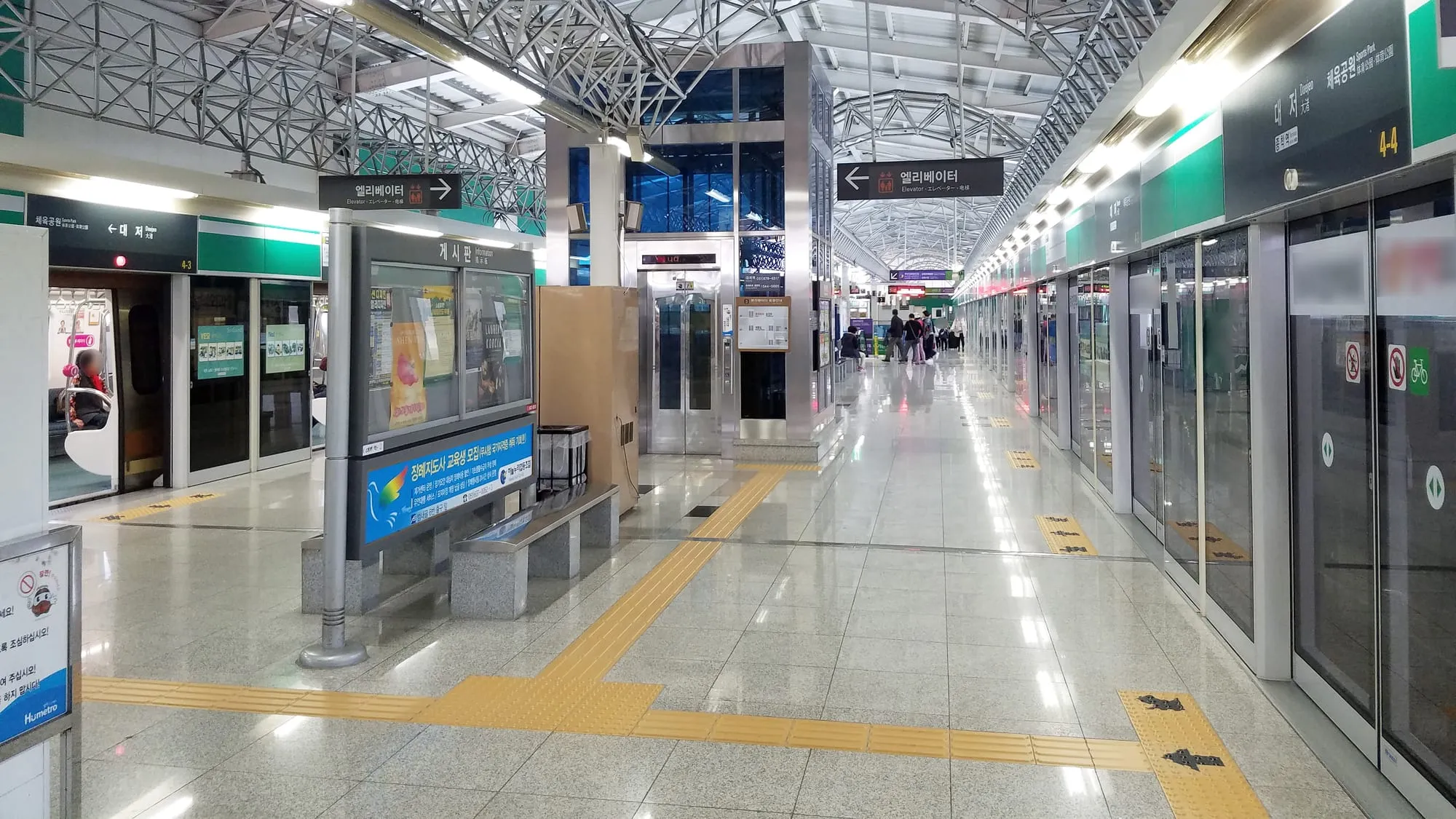
Busan Transportation Guide (2026): Subway, Bus Fares and Cards
Busan transportation for visitors: subway ₩1,600 and buses ₩1,550 on a T-money card, free transfers within 30 minutes, and a ₩6,000 subway day pass.
 Getting Around
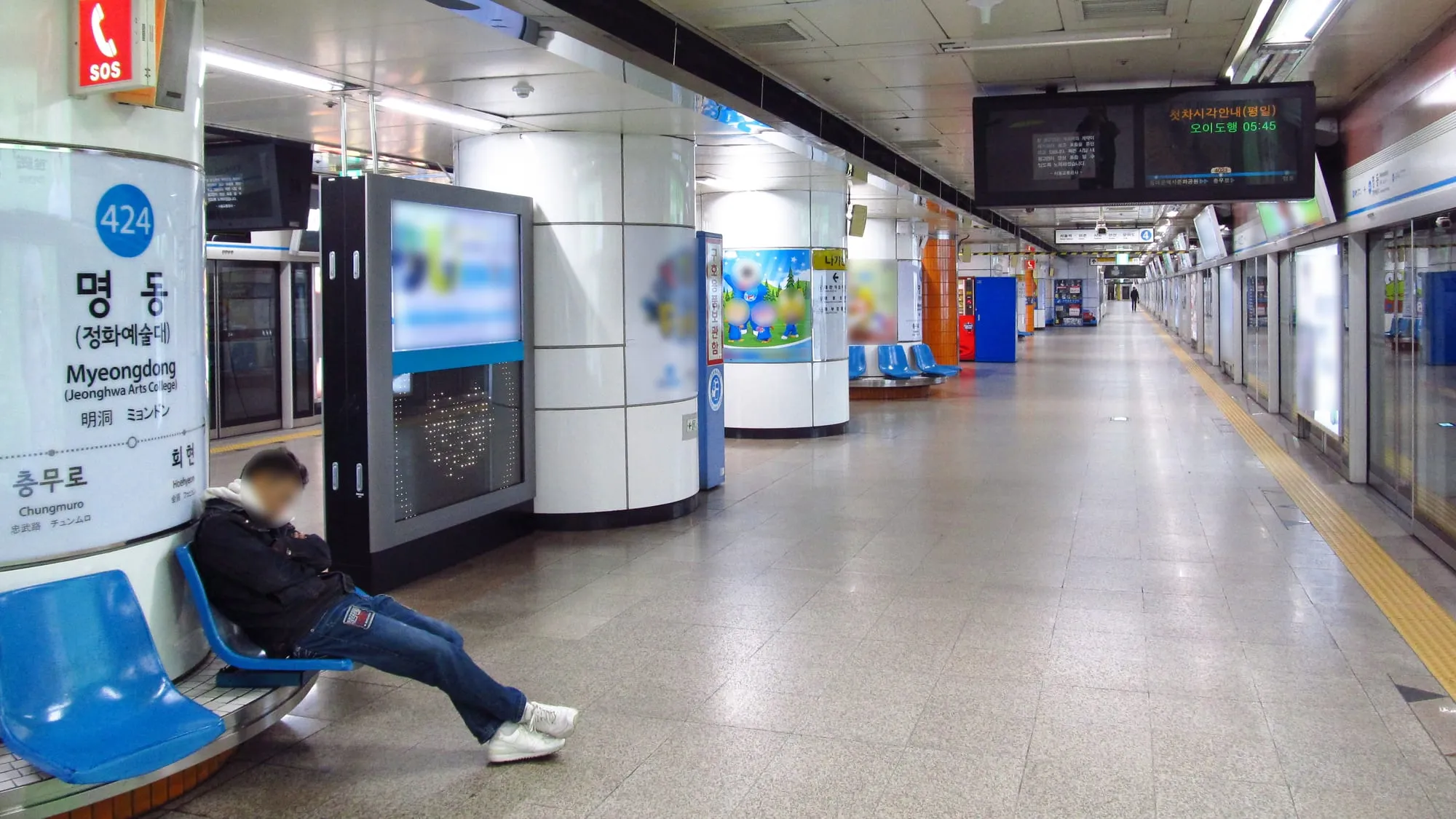
Seoul Subway Guide (2026): Fares, Transfers and Etiquette
Seoul subway guide: a ride costs ₩1,550 by card for 10 km, transfers are free within 30 minutes, and you must tap out. Lines, tickets and seat rules.
 Getting Around
Climate Card or T-money? Which Seoul Transit Card to Buy (2026)
Seoul-only trip with lots of rides? Get a Climate Card short-term pass. Leaving Seoul or riding little? Get T-money. The Korea Tour Card is no longer sold.
Sources
- Jeju Bus Information System — Bus routes, fares, transfers and transit cards (Korean)
- Jeju Bus Information System — Airport limousine 600 and 800 (Korean)
- Jeju Bus Information System — Taxi fares (Korean)
- Jeju Bus Information System — Jeju bus app discontinued, add the website to your home screen (Korean, 27 Jul 2026)
- Jeju Special Self-Governing Province — Cashless buses on all routes from 1 October 2024 (Korean press release)
- Jeju Special Self-Governing Province — Cashless bus pilot from 1 July 2024 (Korean press release)
- Jeju Special Self-Governing Province — Bus route stabilization phase 2, new route 303 from 10 June 2026 (Korean press release)
- Jeju Special Self-Governing Province — Bus public Wi-Fi data expanded (Korean press release, 15 Sep 2026)
- Jeju International Airport (Korea Airports Corporation) — Getting to and from the airport (Korean)
- Jeju Special Self-Governing Province — Okseo Bus on-demand service in all eup/myeon areas (Korean press release, 16 Jun 2026)
- Seoul Metropolitan Government — Climate Card coverage: Seoul-area subway and Seoul-licensed buses (Korean)