Busan Transportation Guide (2026): Subway, Bus Fares and Cards
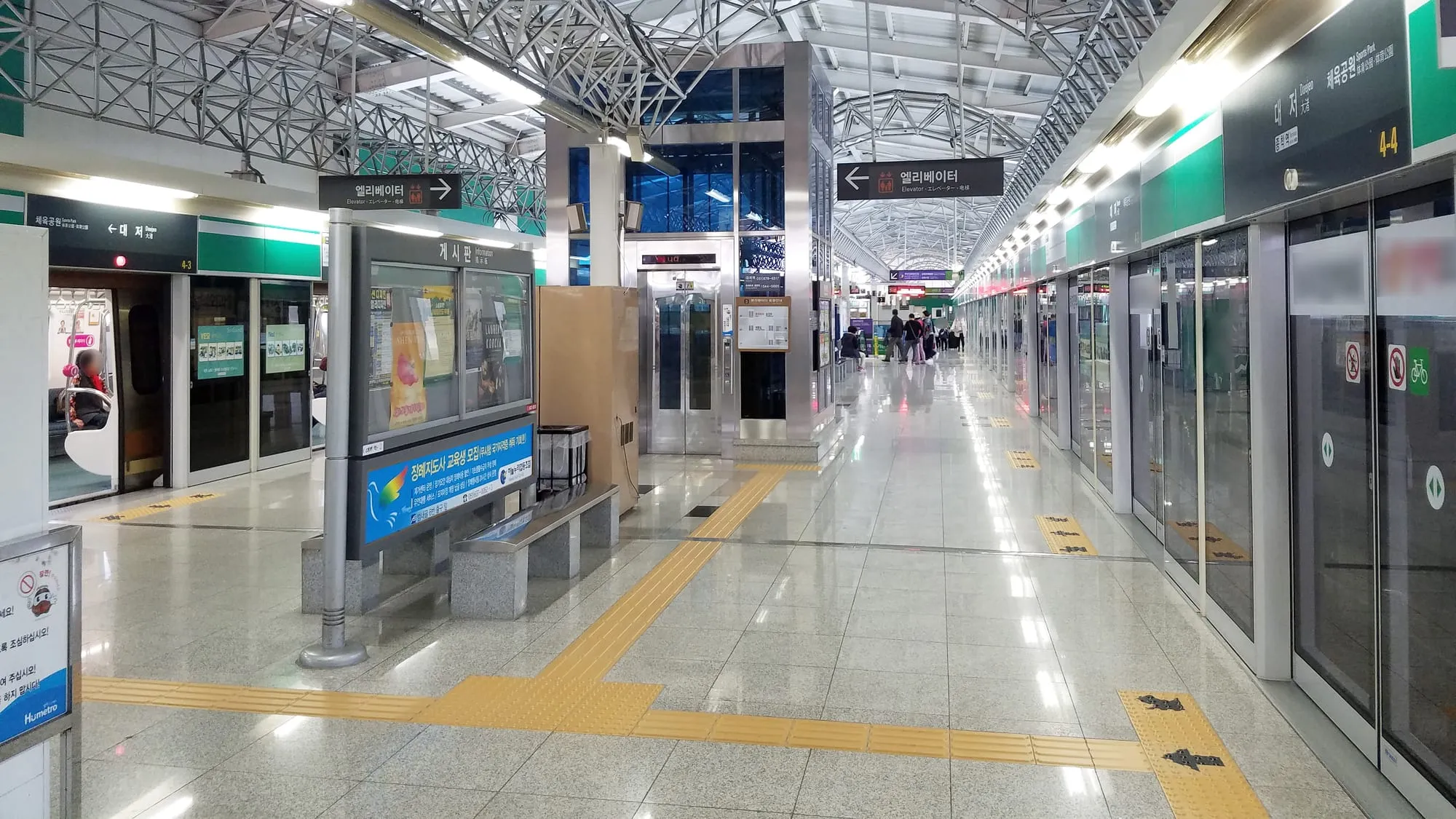
Quick answer: Busan transportation runs on the same transit cards as Seoul: a T-money card works on Busan’s subway, buses and airport light rail, but Seoul’s Climate Card does not. A subway ride costs ₩1,600 (₩1,800 for longer trips) and a city bus ₩1,550 on a card, and transfers within 30 minutes are free. If you’ll take four or more subway rides in a day, buy the ₩6,000 1-day pass in the Busan Metro app, which accepts foreign Visa, Mastercard and JCB cards.
Which card or ticket should you use in Busan?
Use the T-money card you already have, or buy one at a convenience store. T-money works on public transport nationwide, and Busan’s free transfers apply to prepaid and postpaid transit cards.
| Option | What it costs | Covers | Best for |
|---|---|---|---|
| T-money (티머니) or other transit card | Card price, then pay per ride | Subway, buses, light rail, Donghae Line, with free transfers | Most visitors |
| QR single ticket (QR승차권) | ₩1,700 (zone 1) | One subway trip | A one-off ride without a card |
| 1-day / 3-day pass (정기승차권, app) | ₩6,000 / ₩13,000 | Unlimited rides on Busan subway Lines 1–4 | Four or more subway rides a day |
| K-Tour Pass card (케이-투어 패스) | Card free at kiosks; pass ₩15,000 | Stored won for subway and city buses, plus intercity travel and attraction discounts | Foreign visitors coming from Seoul by KTX or bus |
| Climate Card (기후동행카드) | — | Not valid in Busan | Seoul only |
The Climate Card only covers Seoul’s subways and Seoul-licensed buses. If you used one in Seoul, see our T-money vs Climate Card guide and bring a T-money card for Busan.
How much do Busan’s subway and buses cost?
A typical adult ride is ₩1,600 on the subway and ₩1,550 on a regular city bus, paid by transit card. These are Busan Transportation Corporation’s (부산교통공사) current fares.
| Ride | Transit card (adult) | Single ticket / QR (adult) | Teen (13–18) on card |
|---|---|---|---|
| Subway, zone 1 (1구간) | ₩1,600 | ₩1,700 | ₩1,050 |
| Subway, zone 2 (2구간, longer trips) | ₩1,800 | ₩1,900 | ₩1,200 |
| Regular city bus (일반버스) | ₩1,550 | — | ₩800 |
| Seat bus (좌석버스) | ₩2,100 | — | ₩1,350 |
| Busan-Gimhae Light Rail, zone 1 | ₩1,600 | ₩1,700 | ₩1,000 |
Children aged 6 to 12 ride the subway and the light rail free on a transit card. To get child or teen fares, you must register the rider’s date of birth on the card at a convenience store or on the card company’s website.
The subway charges zone 1 or zone 2 depending on how far you travel, based on Busan’s official zone table. If you tap in by mistake and tap again at the same station within 5 minutes, the base fare is waived once.
Is the Busan subway 1-day or 3-day pass worth it?
Yes, if you’ll take four or more subway rides in a day. The 1-day pass (1일권) costs ₩6,000 and the 3-day pass (3일권) ₩13,000, with unlimited rides on Lines 1–4 from the first time you pass a gate.
| Pass | Price | Rides at ₩1,600 to break even |
|---|---|---|
| 1-day | ₩6,000 | 4 rides (₩6,400) |
| 3-day | ₩13,000 | 9 rides (₩14,400) |
The passes don’t cover buses, the Donghae Line (동해선) or the Busan-Gimhae Light Rail. If your day mixes buses and subway, a T-money card with free transfers often costs less.
How to buy the pass:
- Download Busan Subway (부산도시철도), the official app, from Google Play or the App Store.
- Foreign visitors can use it without signing up: enter your email and a verification code. Non-members pay adult fares.
- Buy a 1-day or 3-day pass and pay with a foreign Visa, Mastercard or JCB card.
- At the gate, hold the QR code face down over the QR reader.
Passes you haven’t used at a gate can be refunded in full.
How do transfers work in Busan?
Tap your card when you get off, then board the next bus or train within 30 minutes, and you pay only the most expensive fare of the trip. The rules come from Busan Transportation Corporation’s transfer page:
- Transfers work across Busan, Gimhae and Yangsan, on the subway, buses (including seat and express buses), village buses, the Busan-Gimhae Light Rail and the Donghae Line.
- You can transfer twice, so up to three different vehicles per trip.
- Taking the same mode again doesn’t count. Riding the subway twice, or the same bus number twice, starts a new fare.
- The Donghae Line doesn’t connect to Gimhae or Yangsan transport for transfer discounts.
Example: subway (₩1,600) to a regular bus costs nothing extra; regular bus (₩1,550) to the subway adds ₩50, for a ₩1,600 total.
How do you get from Gimhae Airport into Busan?
Take the Busan-Gimhae Light Rail (부산김해경전철) and change to the subway, or take an airport limousine for Seomyeon or Haeundae. According to Korea Airports Corporation’s (한국공항공사) bus list, both limousine routes leave from stop 3 on the first floor of the domestic and international terminals.
| Option | Fare (adult) | Route | Notes |
|---|---|---|---|
| Light rail + subway | ₩1,600 total on a card (+₩200 for a zone 2 subway trip) | Change at Sasang (Line 2) or Daejeo (Line 3) | Transfer to subway is free within 30 minutes |
| Limousine to Seomyeon/Bujeon | ₩6,000 | Jurye, Dong-eui Univ., Seomyeon Station, Bujeon Market | Departs international terminal 07:20–21:30; no cash |
| Limousine to Haeundae/Gijang | ₩9,500 | Centum City, BEXCO, Haeundae Beach entrance, Jangsan Station | Some departures skip Gijang; no cash |
Pick the light rail if your luggage is light and you’re heading somewhere on the subway, such as Seomyeon on Line 2. Pick a limousine if you have big bags and your hotel is near one of its stops, since it skips the transfer at Sasang or Daejeo.
What changed recently
- 19 September 2025: Busan, Gimhae and Yangsan scrapped the ₩500 adult surcharge on transfers between the three cities. You now pay only the highest single fare.
- 1 December 2025: The Busan Metro app started accepting foreign Visa, Mastercard and JCB cards for single tickets and 1-day and 3-day passes.
- 1 October 2026: Korea’s Ministry of Culture, Sports and Tourism started a K-Tour Pass pilot in Busan for foreign visitors, sold on Klook and Webtour for ₩15,000. The one-day route pass gives 40% off a one-way intercity trip to Busan and a discount on a one-way AREX Express fare; Financial News reports these as KTX or express bus tickets and 50% off AREX Express. Its physical card is free at kiosks in Incheon, Gimpo and Gimhae airports and Seoul and Busan stations, and you load won onto it, with cash or a foreign card, to pay subway and city bus fares.
FAQ
Can I use my Seoul T-money card in Busan?
Yes. T-money works on public transport nationwide, and Busan’s free transfers apply to prepaid transit cards. Top it up at a subway station machine or a convenience store.
Does the Climate Card work in Busan?
No. It only covers Seoul’s subways and Seoul-licensed buses. Use a T-money card or a Busan subway day pass instead.
Do kids ride the Busan subway free?
Children aged 6 to 12 ride the Busan subway and the Busan-Gimhae Light Rail free on a transit card, once their date of birth is registered on the card. QR tickets for children still cost ₩700 on the subway (₩800 for zone 2).
Can I pay for the Busan subway with a foreign credit card?
In the Busan Metro app, yes: Visa, Mastercard and JCB work for single tickets and 1-day and 3-day passes. At the gates themselves, use a transit card or a QR ticket.
Does the 1-day pass cover the airport light rail?
No. The 1-day and 3-day passes cover Busan subway Lines 1–4 only. Pay for the Busan-Gimhae Light Rail with a transit card; the transfer to the subway is then free.
Related guides
 Getting Around
Jeju Without a Car: Bus Routes, Fares and Taxis (2026)
Seeing Jeju without a car works by bus: ₩1,150 per ride on a T-money card, ₩3,000 max on expresses. Buses no longer take cash, so get a card first.
 Getting Around
Seoul Subway Guide (2026): Fares, Transfers and Etiquette
Seoul subway guide: a ride costs ₩1,550 by card for 10 km, transfers are free within 30 minutes, and you must tap out. Lines, tickets and seat rules.
 Getting Around
Climate Card or T-money? Which Seoul Transit Card to Buy (2026)
Seoul-only trip with lots of rides? Get a Climate Card short-term pass. Leaving Seoul or riding little? Get T-money. The Korea Tour Card is no longer sold.
Sources
- Busan Transportation Corporation — Subway fares and day passes (Korean)
- Busan Transportation Corporation — Transfer fares for Busan, Gimhae and Yangsan (Korean)
- Busan Transportation Corporation — Ticket types, transit cards and the mobile app (Korean)
- Busan-Gimhae Light Rail (BGL) — Fares, zones and transfer rules (Korean)
- Korea Airports Corporation — Gimhae Airport by subway and light rail (Korean)
- Korea Airports Corporation — Gimhae Airport buses, incl. limousines (Korean)
- T-money — Cards for foreign visitors, nationwide use (Korean)
- Seoul Metropolitan Government — Climate Card coverage (Korean)
- Ministry of Culture, Sports and Tourism — K-Tour Pass pilot for foreign visitors, 1 Oct 2026 (press release with PDF, Korean)
- Financial News — K-Tour Pass details: price, kiosks, transit payments (Korean)
- Segye Ilbo — Busan Metro app accepts foreign Visa, Mastercard and JCB cards, Dec 2025 (Korean)
- Kyunghyang Shinmun — Busan subway fare rises to ₩1,600, May 2024 (Korean)