Food Allergy in Korea: Labels, Restaurant Rules and Phrases (2026)
Quick answer: With a food allergy in Korea, trust packaged-food labels more than restaurant menus. Korean law makes packaged food flag 19 allergen groups, including peanuts, shellfish, wheat and eggs, but only franchise chains with 50+ outlets selling baked goods, ice cream, burgers or pizza must list allergens at the counter. Sesame and most tree nuts aren’t on the list, so ask in Korean, carry your own epinephrine, and call 119 for a severe reaction.
Which allergens does Korean law require on labels?
Korea’s labeling rules name 19 allergen groups, and any packaged food that uses one of them must say so, no matter how small the amount. The list is in Annex 2 of the Enforcement Rule of the Act on Labeling and Advertising of Foods (식품 등의 표시·광고에 관한 법률 시행규칙), run by the Ministry of Food and Drug Safety (식품의약품안전처, MFDS).
| Allergen (English) | Korean on the label | Notes |
|---|---|---|
| Eggs | 알류 / 달걀 | Poultry eggs only |
| Milk | 우유 | |
| Buckwheat | 메밀 | |
| Peanuts | 땅콩 | |
| Soybeans | 대두 | |
| Wheat | 밀 | |
| Mackerel | 고등어 | The only fish on the list |
| Crab | 게 | |
| Shrimp | 새우 | |
| Pork | 돼지고기 | |
| Peach | 복숭아 | |
| Tomato | 토마토 | |
| Sulfites | 아황산류 / 이산화황 | Only when the final product has 10 mg/kg or more of sulfur dioxide |
| Walnuts | 호두 | |
| Chicken | 닭고기 | |
| Beef | 쇠고기 | |
| Squid | 오징어 | |
| Shellfish | 조개류 | Includes oysters (굴), abalone (전복) and mussels (홍합) |
| Pine nuts | 잣 |
What’s missing matters as much. Sesame (참깨), almonds, cashews, pistachios and other tree nuts apart from walnuts and pine nuts aren’t on the list, and neither is any fish other than mackerel. Barley, rye and oats aren’t listed either. If your allergy is one of these, a label without a warning tells you nothing; read the full ingredient list instead.
Do Korean restaurants have to list allergens?
Most don’t. Under the Special Act on Children’s Dietary Life Safety Management (어린이 식생활안전관리 특별법), only franchise cafés, restaurants and bakeries with 50 or more outlets (counting company-owned and franchised stores together) must show allergens. Even then, MFDS notice 2019-99 covers only baked goods, ice cream, burgers and pizza (plus any other food a business chooses to label).
| Where you eat | Must show allergens? | How it’s shown |
|---|---|---|
| Chain bakery, ice cream, burger or pizza shop (50+ outlets) | Yes, for those foods | Next to the item name or price on the menu, or in a booklet or poster with a sign saying where it is |
| Same chains, ordered in their app or website | Yes | Next to the item name or price online |
| Same chains, phone delivery orders | Yes | Leaflet or sticker with the order |
| Independent Korean restaurants, BBQ, markets, street stalls | No | Ask staff |
| Packaged food from stores | Yes (19 groups) | Allergen box on the pack |
A chain that skips the rule faces a fine of up to ₩3,000,000 (₩1,000,000 for a first offense, ₩2,000,000 for a second, ₩3,000,000 after that). The notice’s own example is a sign saying an allergen information booklet is kept at the counter (“알레르기 유발 식품에 대한 정보표시 책자가 계산대에 비치되어 있습니다”). At a family-run soup or BBQ restaurant, there’s no legal duty to know what’s in the side dishes, so you need to ask.
How do you read a Korean food label?
Turn the pack over and find the ingredient list (원재료명); the allergen box sits right next to it in a different background color. The same rules apply to convenience-store kimbap, snacks and drinks, so our Korean convenience store guide is a good place to practice.
- Find 원재료명. This is the full ingredient list, and the only place an allergen outside the 19 groups (such as sesame, 참깨) will appear.
- Read the allergen box. It lists every listed allergen used, ending in 함유 (“contains”). The official example reads “달걀, 우유, 새우, 이산화황, 조개류(굴) 함유”: eggs, milk, shrimp, sulfur dioxide, shellfish (oyster).
- Look for a cross-contact warning. If the same workers, tools, line or storage handle an allergen, the pack must say so, for example “메밀 혼입 가능성 있음” (may contain buckwheat) or a sentence saying it’s made in the same facility as a product using that allergen.
- Check for 무 글루텐 (gluten-free). Food can carry this label only if it uses no wheat, rye, barley or oats (or uses versions with the gluten removed) and contains no more than 20 mg/kg of gluten.
- Scan the text with a camera translator. Papago’s camera translation can turn the Korean text into English; our Korea travel apps guide covers setup.
To report a mislabeled product, packs carry Korea’s food complaint number, 1399.
Which Korean dishes hide common allergens?
Seafood, buckwheat and sesame turn up where visitors don’t expect them. These are the ones worth asking about before you eat.
- Kimchi (김치): Pusan National University’s Kimchi Research Institute says kimchi mainly uses salted shrimp (새우젓) and salted anchovy (멸치젓). Some kimchi also adds oysters (굴). For a shellfish allergy, treat kimchi as unsafe unless staff confirm otherwise.
- Naengmyeon (냉면) and other cold noodles: Pyeongyang-style naengmyeon is a buckwheat (메밀) noodle, and buckwheat is one of Korea’s listed allergens.
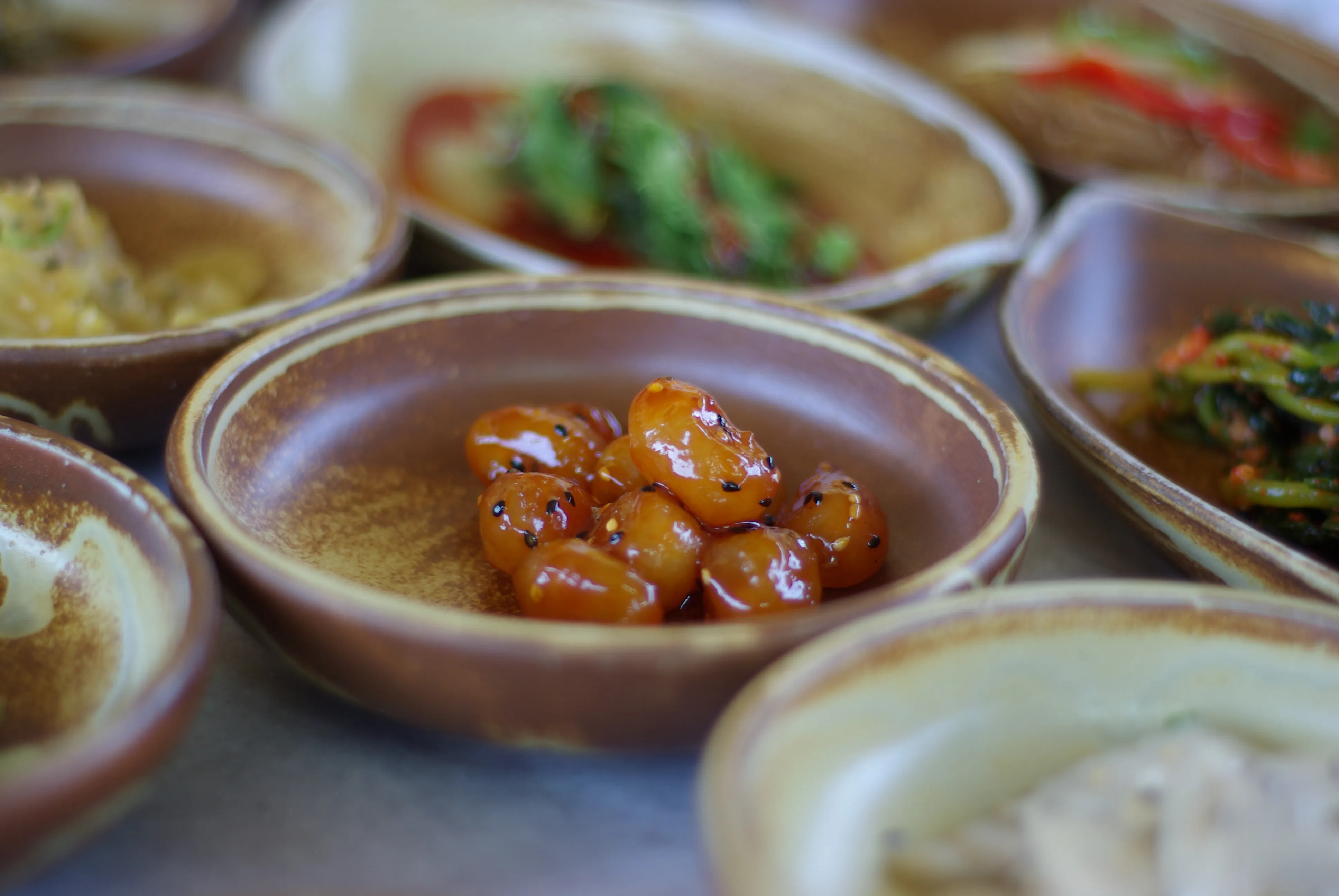
- Side dishes (반찬): sesame oil (참기름) and sesame seeds are common seasonings and garnishes, as the glazed beans in the photo above show. Because sesame isn’t a listed allergen, a pre-packed side dish won’t flag it in the allergen box.
- Broths and stews: a dish described as meat-free can still be built on an anchovy or seafood stock, so ask what the broth (육수) is made from.
Korea’s health agency (KDCA) also warns about cross-reactions: a peanut allergy can extend to walnuts and other nuts, and a milk allergy to goat’s milk.
What should you say at a Korean restaurant?
Show the phrase on your phone before you order, and name the exact allergen in Korean. Point to the dish on the menu when you ask.
| What you want to say | Korean |
|---|---|
| I have a food allergy. | 음식 알레르기가 있어요. |
| I’m allergic to peanuts. | 저는 땅콩 알레르기가 있어요. |
| Does this have shrimp or shellfish in it? | 이거 새우나 조개류 들어가요? |
| Does this have sesame or sesame oil? | 이거 참깨나 참기름 들어가요? |
| Please make it without ___. | ___ 빼 주세요. |
| Even a small amount is dangerous for me. | 조금만 먹어도 위험해요. |
| Please call an ambulance. | 구급차 불러 주세요. |
Swap in the Korean word from the allergen table above, such as 밀 (wheat), 우유 (milk) or 견과류 (tree nuts). If staff can’t confirm the ingredients, a chain outlet with a printed allergen booklet is the safer choice for that meal.
What if you have a severe reaction in Korea?
Call 119 at once; it’s Korea’s ambulance and fire number. VisitKorea also lists the 1330 Korea Travel Hotline (+82-2-1330) for help in English and other languages. KDCA’s anaphylaxis steps are to stop eating the likely cause, lay the person flat, call 119 and ask people nearby for help, inject epinephrine into the outer thigh if you have an auto-injector, raise the legs, and get to an emergency room quickly, because a second reaction can follow.
Bring your own epinephrine. The auto-injector approved in Korea is Jext (젝스트), in 150 and 300 microgram pens, and MFDS classes it as a prescription-only medicine (전문의약품). That means you’d need to see a Korean doctor first, and you’d still have to find a pharmacy that has it.
Ordinary prescription medicines brought for your own use fall under Korea’s general allowance: up to 6 bottles or a 3-month supply, according to the Korean consulate in Atlanta. Pack it in your carry-on with your prescription or pharmacy label, and carry it with you at every meal.
FAQ
Do Korean restaurants have allergen menus?
Only some chains must. Franchise cafés, restaurants and bakeries with 50 or more outlets have to show allergens for baked goods, ice cream, burgers and pizza. Independent Korean restaurants have no such duty, so ask staff directly.
Is sesame labeled as an allergen in Korea?
No. Sesame isn’t one of the 19 allergen groups in Korean law, so it won’t appear in the allergen box. Check the full ingredient list (원재료명) for 참깨 or 참기름.
Can I buy an EpiPen in Korea?
Not over the counter. The auto-injector approved in Korea, Jext, is prescription-only, so you’d need a Korean doctor’s prescription. Bring enough of your own for the whole trip.
Is “gluten-free” a regulated label in Korea?
Yes. 무 글루텐 may only be used when a food has no wheat, rye, barley or oats (or versions with gluten removed) and no more than 20 mg/kg of gluten in total.
Is kimchi safe with a shellfish allergy?
Usually not. Kimchi is mainly seasoned with salted shrimp or salted anchovy, and some kimchi adds oysters. Ask before eating it, and assume the side-dish kimchi contains seafood.
Related guides
 Trip Planning
Bring Medication to Korea: Which Pills Need MFDS Approval (2026)
Bringing medication to Korea: up to 6 bottles or 3 months is fine, but Ritalin, sleeping pills and codeine need MFDS approval 10+ days before you fly.
 Trip Planning
Christmas in Seoul 2026: Lights, New Year's Countdown and What's Open
Christmas in Seoul 2026: where the lights are, how the Bosingak bell and countdowns work, the 2 a.m. subway extension on Dec 31, and what's open.
 Trip Planning
Ski Resorts Near Seoul: Shuttles, Lift Prices and Day Trips (2026)
The closest ski resorts near Seoul are Konjiam, Jisan and Elysian Gangchon, each reachable by train or shuttle. Lift prices, rentals and how to get there.
Sources
- Korean Law Information Center — Enforcement Rule of the Act on Labeling and Advertising of Foods, Annex 2: allergen list, allergen box, cross-contact warning, gluten-free (Korean, in force 1 Jan 2026)
- Korean Law Information Center — Special Act on Children's Dietary Life Safety Management, Art. 11-2 (allergen display) and Art. 29 (fines) (Korean)
- Korean Law Information Center — Enforcement Decree of the same Act, Art. 8: franchises with 50 or more outlets (Korean, in force 12 May 2026)
- MFDS notice 2019-99 — Allergen display standards for children's favorite foods: bakery, ice cream, burgers, pizza; menu boards, booklets, apps (Korean)
- Korea Disease Control and Prevention Agency (KDCA) health portal — Managing food allergy: MFDS allergen foods, cross-reactions, anaphylaxis response (Korean, 2025)
- MFDS Drug Safety Korea — Jext prefilled pen 300 micrograms (epinephrine), prescription-only, approved 14 Dec 2017 (Korean)
- MFDS Drug Safety Korea — Jext prefilled pen 150 micrograms (epinephrine), prescription-only, approved 14 Dec 2017 (Korean)
- Consulate General of Korea in Atlanta — Medicines for travelers to Korea: 6 bottles or three months' supply (12 May 2026)
- VisitKorea (Korea Tourism Organization) — Emergency situations: emergency numbers and 1330 (updated 11 Sep 2026)
- Pusan National University Kimchi Research Institute — Kimchi ingredients: salted shrimp and anchovy jeotgal, oysters, factory kimchi mix (Korean)
- VisitKorea — Eulmildae Pyeongyang Naengmyeon: cold buckwheat noodles
- Korea Experience — Navigating Korean restaurant menus with allergies: jeotgal, sesame and cross-contact (12 Oct 2026)