Halal Food in Seoul: Restaurants, Mosque and Prayer Rooms (2026)
Quick answer: Halal food in Seoul is concentrated in Itaewon, on the streets around Seoul Central Mosque (서울중앙성원), where halal restaurants, a halal butcher and halal grocery stores sit side by side. Only two of the Korea Tourism Organization’s four restaurant labels mean everything on the menu is halal: Halal Certified and Self-certified. For prayer, the mosque welcomes visitors 10:30–17:00, COEX has a prayer room on the 3rd floor, and Incheon Airport’s prayer rooms are open 24 hours.
Facts below come from the Korea Muslim Federation (한국이슬람교중앙회, KMF), the Korea Tourism Organization (KTO), Incheon Airport and COEX, checked on October 17, 2026.
What do the halal labels on Korean restaurants mean?
KTO sorts Muslim-friendly restaurants into four groups, and only the first two are fully halal. “Muslim Friendly” and “Pork free” places can still serve alcohol, and pork-free does not mean the meat is halal.
| KTO label | What it means | Alcohol | Pick it if… |
|---|---|---|---|
| Halal Certified | Certified by an accredited body such as the Korea Muslim Federation (KMF) | Not stated by KTO | You need an outside certificate |
| Self-certified | All food is halal; the Muslim owners certify it themselves | Not stated by KTO | You trust a Muslim-run kitchen |
| Muslim Friendly | Some halal dishes on the menu | May be sold | You’re with non-Muslim friends and order from the halal dishes |
| Pork free | No halal menu, but no pork is used | May be sold | You eat seafood or vegetarian dishes only |
KTO adds one warning: hotel restaurants and buffets labeled “Muslim-friendly” may serve dishes that contain pork. At a hotel buffet, ask staff which dishes are halal before you fill your plate.
The labels are KTO’s; the certificate itself comes from a certifier such as KMF, which is based at Seoul Central Mosque. We couldn’t find a public list of KMF-certified businesses on KMF’s website, so ask to see the certificate on the wall if it matters to you.
Where can you find halal restaurants in Seoul?
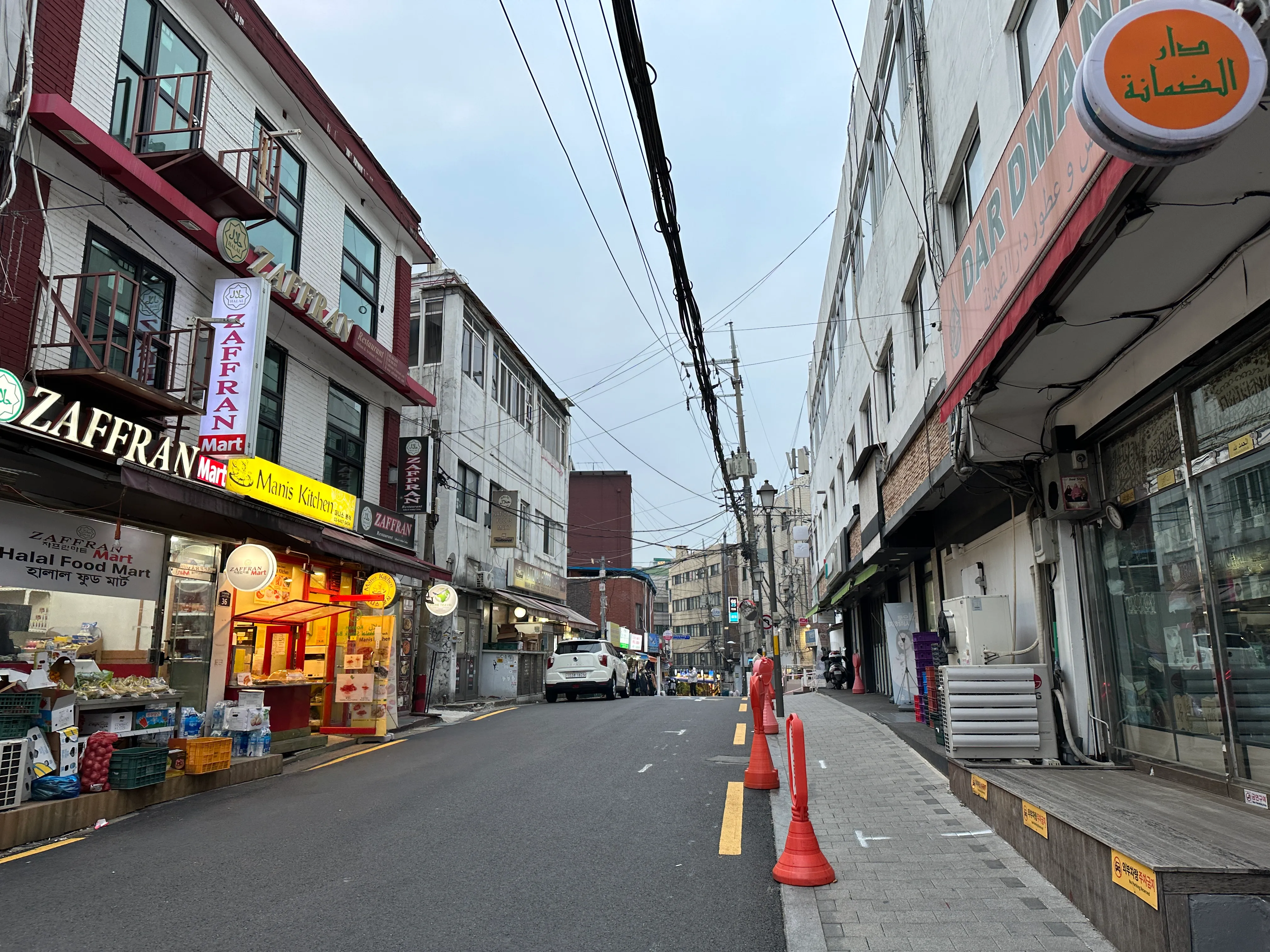
Start at the mosque in Itaewon. KMF says the streets outside Seoul Central Mosque are lined with halal restaurants, a halal butcher (할랄 정육점), an Islamic bookstore and halal supermarkets (할랄 슈퍼).
| Area | Where exactly | What you’ll find |
|---|---|---|
| Itaewon mosque street | Usadan-ro 10-gil (우사단로10길), the lane up to the mosque | Halal restaurants, butcher, grocery stores |
| Itaewon main road | Itaewon-ro (이태원로), below the mosque | Turkish restaurants |
| Hongdae and Gangnam | Around Hongdae and Gangnam Station | Self-certified and Muslim-friendly restaurants |
Visit Seoul’s guide for Muslim travelers, last edited in August 2026, says Seoul’s options range from self-certified and Muslim-friendly places to officially certified halal restaurants. It doesn’t name them, so check the label or ask to see the certificate.
Restaurants in Itaewon open and close often. Search the name in Naver Map before you go: it shows whether a place is still open and its current hours. Our Naver Map guide explains how to set it to English.
How do you visit Seoul Central Mosque?
Anyone can visit Seoul Central Mosque (서울중앙성원) without booking, between 10:30 and 17:00. It opened on May 21, 1976, as Korea’s first mosque, and KMF has its headquarters there.
Getting there:
- Take Line 6 to Itaewon Station (이태원역) and leave by exit 3.
- Turn right at the Itaewon fire station (이태원 소방서).
- Turn left at the junction by Bogwang Elementary School (보광초등학교).
- Walk straight for about 250 m. The address is 39 Usadan-ro 10-gil, Yongsan-gu (서울 용산구 우사단로10길 39).
The prayer halls are on the 1st and 2nd floors, and the annex has separate ablution (wudu) rooms for men and women on the basement level. KMF lists entering the prayer hall itself among the things visitors may not do.
KMF asks visitors to follow these rules:
- No revealing clothes such as short skirts. If you need to cover up, skirts and hijabs are kept in a changing room next to the guard post.
- No pets, smoking, drinking or loud noise.
- No photos during prayer, and no photos of people without their consent.
The grounds get busy for 30 minutes before and after each daily prayer and on Fridays from 12:00 to 15:00, when guided visits may not be possible. For questions, call 02-793-6908.
Where can you pray in Seoul?
Visit Seoul counts about 10 main prayer rooms (기도실) in the city, in places such as airports, major attractions, large hospitals and the Itaewon mosque, but doesn’t list them. Hours differ a lot, so check the place before you rely on it.
| Place | Location / type | Hours | Source |
|---|---|---|---|
| Seoul Central Mosque | 39 Usadan-ro 10-gil, Itaewon | Visitors 10:30–17:00 | KMF |
| COEX | 3rd floor, near Hall E | 8:30–18:00 | COEX |
COEX opened its prayer room in 2016 with separate spaces for men and women, a qibla sign, Qurans and prayer carpets.
KTO has given prayer mats and qibla compasses to hotels that have a prayer or multi-faith room, so ask your hotel’s front desk too. KMF publishes a monthly prayer timetable for Seoul (Muslim World League method) and gives the qibla as 285.8° (west-northwest).
Where are the prayer rooms at Incheon Airport?
Incheon Airport has prayer rooms in both terminals, open 24 hours. The two in Terminal 1 are both past security, so you can use them only after passport control.
| Terminal | Location | Area |
|---|---|---|
| Terminal 1 | 3rd floor, near Gate 24 | Airside (duty-free area) |
| Terminal 1 | 4th floor, west transfer lounge | Airside (duty-free area) |
| Terminal 2 | Basement level 1, general area | Before security |
| Terminal 2 | 4th floor, duty-free area | Airside |
The Terminal 2 locations come from Incheon city’s tourism site (updated June 2026); Incheon Airport’s own Korean facilities page lists only the Terminal 1 rooms. Check the airport map or call 1577-2600 if you need the exact spot. For getting into the city after you land, see our Incheon Airport to Seoul guide.
How do you spot pork on Korean food labels?
Look for the word 돼지고기 (pork) on the back of the pack. Under Ministry of Food and Drug Safety (MFDS) rules, pork, beef and chicken are on Korea’s list of allergens that must be declared on packaged food, whatever the amount.
The allergen line sits near the ingredient list in a box with a different background color, so it’s easy to find on convenience-store kimbap, ramyeon and snacks. If a factory also handles pork on the same line, the label must carry a cross-contamination warning.
| Korean word | Meaning |
|---|---|
| 돼지고기 (dwaeji-gogi) | Pork |
| 쇠고기 / 소고기 (so-gogi) | Beef |
| 닭고기 (dak-gogi) | Chicken |
| 할랄 (hallal) | Halal |
| 알코올 / 주류 (alkol / juryu) | Alcohol |
A beef or chicken label does not tell you how the animal was slaughtered, so treat meat products without a halal mark as non-halal. In restaurants, the simplest question is “돼지고기 들어가요?” (Is there pork in it?).
FAQ
Is Korean food halal?
Not by default. Ordinary Korean restaurants don’t use halal-certified meat unless they say so, so look for KTO’s Halal Certified or Self-certified label, or eat in the Muslim-run restaurants around Itaewon’s mosque.
Can non-Muslims visit Seoul Central Mosque?
Yes. Individual visitors can walk in between 10:30 and 17:00 without booking, but visitors may not go inside the prayer hall and must dress modestly. Groups and interview or filming requests should apply through KMF’s website first.
Is “Muslim friendly” the same as halal?
No. KTO’s Muslim Friendly label means only some dishes are halal and the restaurant may serve alcohol. For a fully halal kitchen, choose a Halal Certified or Self-certified place.
Are there mosques outside Seoul?
Yes. KMF counts about 20 mosques and about 135 smaller prayer places (musalla) across Korea, including the Busan mosque in Geumjeong-gu (부산성원) and the Jeju Islamic Center (제주이슬람센터) in Jeju City.
What time is Friday prayer at Seoul Central Mosque?
KMF doesn’t post a fixed time, but it says the mosque is busiest on Fridays from 12:00 to 15:00. Check KMF’s monthly prayer timetable for that day’s midday prayer time.
Related guides
 Trip Planning
Lost and Found in Seoul: Subway, Taxi, Airport and Police (2026)
Lost and found in Seoul: tell station staff your train time and door number, check Seoul Metro's four centers, then search found items on Police Minwon24.
 Trip Planning
Doctor in Korea as a Tourist: Clinics, Pharmacies, 119 and 1330 (2026)
Seeing a doctor in Korea as a tourist: call 119 in emergencies, use a local clinic for minor illness, and expect to pay the full bill without insurance.
 Trip Planning
Korea Weather by Month: Temperatures, Rain and What to Pack (2026)
Korea weather by month from official 1991–2020 data: Seoul highs and lows, the July rainy season, dust season and a packing list for each month.
Sources
- Korea Muslim Federation — Seoul Central Mosque introduction (Korean)
- Korea Muslim Federation — Directions to Seoul Central Mosque (Korean)
- Korea Muslim Federation — Visiting hours and visitor rules (Korean)
- Korea Muslim Federation — Monthly prayer timetables (Korean)
- Korea Muslim Federation — FAQ: number of mosques and prayer places (Korean)
- Korea Tourism Organization — Muslim-friendly travel: restaurant categories (English)
- Incheon Airport — Convenience facilities: prayer rooms (Korean)
- Incheon Metropolitan City tourism — Muslim-friendly Incheon: airport prayer rooms (English, updated Jun 22, 2026)
- COEX — Facilities: Muslim prayer room near Hall E (English)
- COEX — Coex opens Muslim prayer room for Muslim guests (English, Jan 28, 2016)
- Korea Muslim Federation — Mosques and branches across Korea (Korean)
- Visit Seoul (Seoul Tourism Organization) — If you are a Muslim traveler (English, edited Aug 21, 2026)
- Ministry of Food and Drug Safety — Food labeling system: allergen list incl. pork (English)